
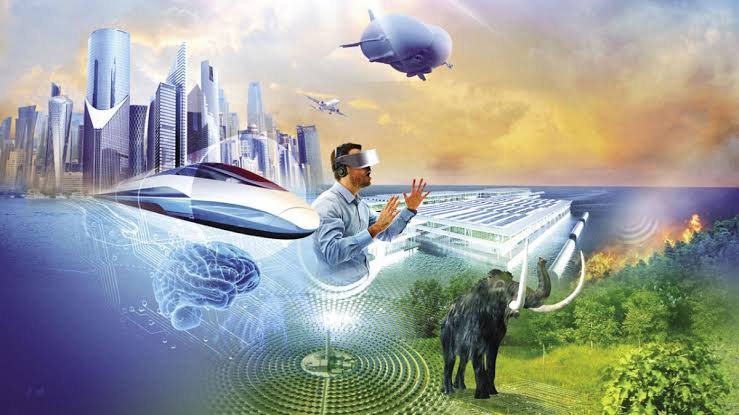
Artificial intelligence has moved from the pages of science fiction into everyday reality. Not long ago, the idea of having a computer that could understand human language, recognize images, create content, or make complex predictions seemed far away. Today, AI is already helping people work, learn, communicate, shop, travel, and solve problems.
The rapid rise of artificial intelligence is changing the technology industry and influencing almost every major sector of the economy. Businesses are investing in AI to improve productivity, governments are exploring ways to regulate it, researchers are developing increasingly capable systems, and individuals are discovering new ways to use AI tools in their daily lives.
But the rise of AI is about more than today’s technology. It raises a much bigger question:
What could the future of technology look like as artificial intelligence becomes more powerful?
The answer is not completely predictable. Some changes are already visible, while others may take years to develop. What is clear is that AI is likely to become a deeper part of the digital world, changing how people interact with computers and how technology solves problems.
This article explores the future of artificial intelligence, the technologies driving its growth, the industries it could transform, the opportunities it may create, and the challenges society will need to address.
What Is Driving the Rise of AI?
Artificial intelligence has existed as a field of research for decades, but recent advances have dramatically increased its capabilities.
Several factors are contributing to the current AI boom.
More Powerful Computing
Modern computers can process enormous amounts of information much faster than earlier generations of machines.
Specialized hardware designed for AI workloads has also made it possible to train and run increasingly sophisticated models.
More computing power allows researchers to build systems capable of handling complex tasks involving language, images, audio, video, and other types of data.
The Growth of Big Data
AI systems need information to learn patterns.
The digital world produces huge quantities of data every day through websites, smartphones, sensors, businesses, scientific research, and connected devices.
This abundance of data has created opportunities to train increasingly capable machine learning models.
Better Algorithms
AI researchers have developed more sophisticated methods for training machine learning and deep learning systems.
These advances have improved computers’ ability to understand language, recognize objects, generate content, and make predictions.
Greater Accessibility
AI is no longer limited to large research laboratories.
Businesses, developers, students, creators, and ordinary consumers can access powerful AI tools through applications and online platforms.
This wider accessibility is accelerating experimentation and adoption.
AI Is Changing How We Interact With Computers
For decades, interacting with computers generally required users to understand specific interfaces, commands, or software systems.
AI is changing that relationship.
Instead of learning complicated software menus, people can increasingly communicate with computers using natural language.
Users can ask questions, describe a problem, request an explanation, analyze information, generate content, or ask for assistance with a task.
This could make technology accessible to people who are not technically experienced.
In the future, computers may become less like tools that people must learn and more like intelligent assistants that adapt to the way people communicate.
The Future of AI-Powered Personal Assistants
Digital assistants are likely to become much more capable.
Today’s assistants can perform relatively simple tasks such as answering questions, setting reminders, or controlling smart devices.
Future AI assistants could potentially manage more complicated workflows.
For example, an assistant might help organize a busy schedule, compare options, summarize important information, prepare documents, coordinate meetings, or help manage routine administrative work.
Instead of simply responding to individual commands, future AI systems may become more proactive.
They could recognize patterns in a user’s activities and offer useful assistance before being explicitly asked.
However, greater capability also means greater responsibility. People will need clear controls over what AI assistants can access and what actions they are allowed to perform.
AI and the Future of Work
The workplace will likely be one of the areas most affected by AI.
AI can already automate repetitive tasks and help employees analyze information, write drafts, summarize documents, create presentations, and perform research.
As AI systems become more capable, businesses may automate increasingly complex workflows.
This does not necessarily mean that humans will become unnecessary.
Instead, many jobs may change.
Employees may spend less time performing routine activities and more time focusing on strategy, creativity, relationships, decision-making, and problem-solving.
At the same time, some roles may decline while new professions emerge.
Skills related to AI development, data analysis, cybersecurity, AI governance, automation, and technology management could become increasingly important.
The future workplace may therefore be defined by human-AI collaboration rather than simply human workers or automated machines.
AI Could Transform Healthcare
Healthcare is another field where artificial intelligence could have a major impact.
AI systems can analyze enormous quantities of medical information and help identify patterns in images, patient records, and scientific research.
In the future, AI could increasingly support medical professionals with early detection, personalized treatment planning, drug discovery, and administrative tasks.
Researchers may also use AI to examine biological data and accelerate the search for new treatments.
However, healthcare is a high-stakes environment. AI-generated recommendations must be carefully tested and reviewed by qualified professionals.
The future of AI in healthcare will therefore depend not only on technical capability but also on safety, regulation, privacy, and human oversight.
Smarter Transportation
Transportation could also become significantly more intelligent.
AI is already used in navigation systems and advanced driver-assistance features.
Future transportation systems may use AI to coordinate vehicles, manage traffic, predict maintenance requirements, and optimize routes.
Autonomous vehicles could potentially reduce the need for human control in certain environments if the technology becomes sufficiently reliable and regulations permit wider adoption.
AI could also help public transportation systems operate more efficiently by analyzing passenger demand and traffic patterns.
The long-term goal is not simply to make vehicles autonomous. It is to create transportation systems that are safer, more efficient, and better connected.
AI and Smart Cities
The rise of AI could transform cities as well.
Modern cities generate enormous quantities of information through traffic systems, public transportation, energy networks, environmental sensors, and public services.
AI could help analyze this information and identify ways to improve urban life.
For example, intelligent systems could help manage traffic lights, detect infrastructure problems, optimize energy use, and improve waste collection.
Smart city technology could also help governments understand where public resources are most needed.
However, collecting large amounts of information about citizens raises significant privacy concerns. Smart cities will need strong safeguards to ensure that technology improves public services without unnecessarily compromising individual privacy.
The Future of Education
Education could become increasingly personalized through AI.
Traditional classrooms often require teachers to work with students who have different learning speeds, interests, and needs.
AI-powered learning systems could provide individualized practice and explanations based on each student’s progress.
A student who struggles with a particular topic could receive additional exercises, while a student who understands the material quickly could move to more advanced challenges.
Teachers could use AI to reduce administrative workloads and gain additional insights into student progress.
However, technology cannot replace the human relationship at the heart of education. Teachers provide encouragement, mentorship, emotional support, and social guidance.
The future may therefore combine intelligent educational tools with human-centered teaching.
AI Could Accelerate Scientific Discovery
One of the most exciting possibilities is the use of AI in scientific research.
Scientists often have to analyze enormous datasets. AI can process information and identify patterns much faster than humans can manually examine every data point.
This could support research in areas such as medicine, climate science, physics, biology, materials science, and astronomy.
AI could help researchers generate hypotheses, analyze experiments, simulate complex systems, and search through large scientific datasets.
The technology will not eliminate the need for scientists. Instead, it could give researchers powerful new tools for exploring questions that were previously difficult or impossible to investigate.
The Rise of Robotics
AI is also becoming increasingly connected to physical machines.
Robots can combine artificial intelligence with cameras, sensors, motors, and other hardware to interact with the physical world.
In the future, AI-powered robots could become more common in manufacturing, warehouses, agriculture, healthcare, and other industries.
Household robotics may also develop further.
The long-term challenge is teaching machines to operate safely in unpredictable real-world environments. A factory floor is relatively controlled, but a home filled with people, pets, furniture, and constantly changing conditions is much more complicated.
AI and Creativity
One of the most surprising developments in AI has been its growing ability to generate creative content.
Modern generative AI can produce text, images, music, video, software code, and other forms of content.
This is changing how creative professionals work.
Writers, designers, developers, marketers, and other creators can use AI to brainstorm ideas, produce initial drafts, experiment with concepts, or automate repetitive parts of their workflow.
At the same time, generative AI raises difficult questions about originality, copyright, misinformation, and the role of human creativity.
The future of creative work may not be about choosing between humans and AI. Instead, creators may use AI as a tool while remaining responsible for the ideas, decisions, quality, and meaning behind the final work.
AI and Cybersecurity
As technology becomes more intelligent, cybersecurity will become even more important.
AI can help organizations identify unusual activity, detect potential threats, and analyze large amounts of security information.
But attackers can also use AI to develop more sophisticated methods.
This creates an ongoing technological competition between defenders and attackers.
Future cybersecurity systems may rely heavily on AI to identify threats quickly and respond to them automatically.
Organizations will need to combine these technologies with strong security policies, skilled professionals, and responsible human oversight.
The Importance of Responsible AI
The future of AI will not be determined only by what technology can do.
It will also depend on how society chooses to use it.
Several issues deserve serious attention.
Privacy
AI systems can process enormous amounts of personal information. Organizations must protect sensitive data and provide transparency about how it is used.
Bias
AI models can reproduce patterns of bias present in their training data. Developers need to test systems carefully and work to reduce unfair outcomes.
Misinformation
AI-generated content can make false information more convincing and easier to produce. Society will need stronger digital literacy and verification practices.
Security
Powerful AI systems need appropriate safeguards to prevent misuse and unauthorized access.
Human Oversight
Important decisions should not automatically be handed over to machines. People need to understand when human judgment is necessary.
Will AI Become Smarter Than Humans?
One of the biggest questions about the future of artificial intelligence concerns how capable AI systems will eventually become.
Today’s AI can perform many impressive tasks, but it still has significant limitations. It can make mistakes, misunderstand context, produce inaccurate information, and struggle with certain forms of reasoning.
Researchers continue to debate how far AI capabilities will eventually progress.
Rather than focusing entirely on predictions about machines becoming “superintelligent,” it is more useful to consider the practical changes happening now.
AI is becoming capable enough to transform many individual tasks and industries.
That alone could have enormous economic and social consequences.
What Skills Will Matter in an AI-Powered Future?
As AI changes the workplace, human skills will remain important.
People may need to become better at:
- Critical thinking
- Creativity
- Communication
- Problem-solving
- Collaboration
- Leadership
- Adaptability
- Emotional intelligence
- Evaluating information
- Working effectively with AI tools
Technical skills will certainly matter, but people will also need the ability to understand when AI should and should not be trusted.
Knowing how to question an AI-generated answer may become just as important as knowing how to generate one.
How Businesses Can Prepare for the Future of AI
Businesses that want to benefit from AI should focus on practical problems rather than adopting technology simply because it is popular.
A good starting point is identifying repetitive tasks that consume employee time or processes where better data analysis could improve decision-making.
Companies should also invest in employee training.
AI adoption works best when employees understand both the benefits and limitations of new systems.
Organizations should establish clear policies covering data privacy, security, accuracy, and responsible AI use.
The most successful businesses may be those that combine advanced technology with strong human expertise.
What Could Everyday Life Look Like?
Imagine waking up in a home where intelligent systems understand your routine.
Your devices could automatically adjust temperature and lighting. An AI assistant could summarize important messages, organize your schedule, and help you prepare for the day.
Your transportation system could choose efficient routes based on real-time conditions.
At work, AI could handle routine administrative tasks while you focus on decisions and collaboration.
In education, intelligent systems could personalize learning.
In healthcare, AI could help professionals identify potential problems earlier.
Some of these ideas may sound futuristic, but pieces of this future already exist today.
The major change will be how these technologies become connected and integrated into everyday life.
The Challenges of an AI-Driven Future
The future of AI will not be perfect.
Technological progress can create economic disruption, inequality, privacy concerns, and new forms of security risk.
Some workers may find it difficult to transition as certain tasks become automated.
People who have access to advanced technology and education may benefit more quickly than those who do not.
This makes digital education and access to technology increasingly important.
Governments, businesses, educators, and communities will all have a role in making sure the benefits of AI are distributed as widely as possible.
Conclusion
The rise of AI is one of the most important technological developments of our time.
Artificial intelligence is already changing how people search for information, communicate, work, shop, travel, learn, and create. In the coming years, its influence could become even greater.
AI may help build smarter cities, more personalized education systems, more efficient businesses, advanced healthcare tools, intelligent transportation networks, and powerful scientific research systems.
But the future of technology should not be measured only by how intelligent machines become.
It should also be measured by how responsibly we use them.
AI has enormous potential, but technology alone cannot decide what kind of future society should build. Humans still need to establish values, make ethical choices, protect individual rights, and decide where technology belongs.
The most promising future may be one where artificial intelligence handles tasks that machines are good at while humans continue to provide creativity, empathy, judgment, and purpose.
The rise of AI is already underway. The bigger question is not whether artificial intelligence will change the future—it is how we choose to shape that future with it.
Frequently Asked Questions About the Future of AI
What is the future of artificial intelligence?
The future of AI is likely to involve more capable digital assistants, automated workflows, personalized services, intelligent robotics, advanced healthcare applications, smarter transportation, and greater integration between AI and everyday technology.
Will AI change the way people work?
Yes. AI is likely to automate some repetitive tasks while changing how people perform many existing jobs. It may also create new roles involving AI development, management, cybersecurity, data analysis, and human-AI collaboration.
Will AI replace humans?
AI may replace certain tasks and potentially some roles, but many activities require human judgment, creativity, empathy, communication, and responsibility. Human-AI collaboration is likely to remain important.
Why is AI growing so quickly?
The growth of AI is being driven by more powerful computing, large datasets, improved algorithms, better AI models, and greater access to AI-powered tools.
What are the biggest risks of AI?
Major concerns include privacy, bias, misinformation, cybersecurity threats, job disruption, unreliable outputs, and the potential misuse of increasingly powerful AI systems.
How can people prepare for an AI-powered future?
People can prepare by developing digital skills, learning how AI tools work, improving critical thinking, staying adaptable, and building human skills such as communication, creativity, leadership, and problem-solving.
Will AI become part of everyday life?
AI is already part of everyday life, and its integration is likely to increase. Future AI systems may become more deeply connected to smartphones, homes, vehicles, workplaces, education, healthcare, and other services.
I can also create the next articles in this series using the same SEO structure, tone, keyword strategy, article length, headings, and FAQ format so they feel like one consistent AI-focused website.